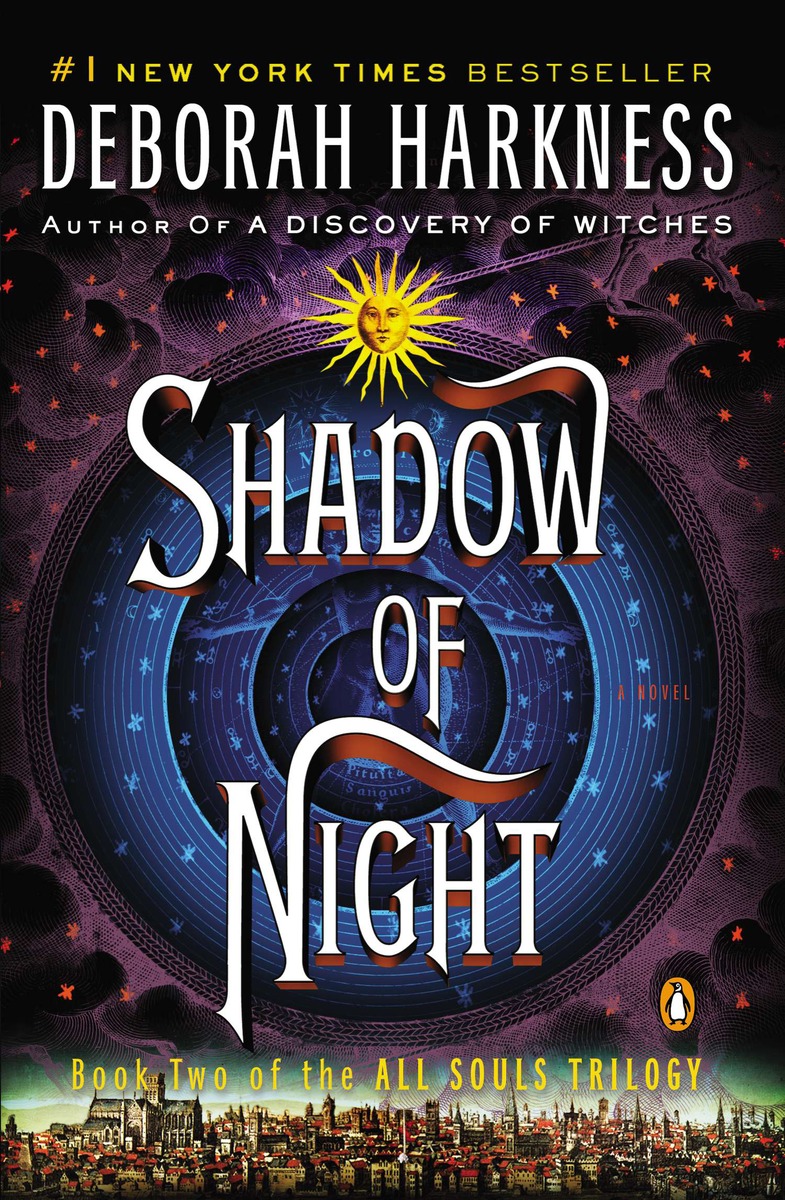
Shadow of Night is a historical fantasy book by Deborah Harkness. It’s the sequel to A Discovery of Witches. The book picks up directly where A Discovery of Witches ended.
I was excited to start this book because I enjoyed A Discovery of Witches so much. Deborah Harkness brings the reader directly into Elizabethan London, where Diana and Matthew must search for Ashmole 782 while encountering the School of Night and other secrets from Matthew’s past.
Like the first book, it’s entirely written in first-person point of view, so the reader only gets Diana’s view of the events. Since Diana is a historian, readers get rich worldbuilding. Everything gets dissected and explained, including the setting, attire, and food. Those who enjoy a deep dive into historical fantasy will definitely enjoy this novel. However, there’s a caveat. More on this later.
What I enjoyed about this novel was the relationship between Matthew and Dianna. They acted like a couple, and they were still themselves; their own characters. Each had their needs and wants, and they weren’t merged into one person. The relationship felt like a tug of war as the couple navigated situations.
This was largely due to getting to know more about Matthew, his family members, and his hidden life. It was a source of conflict, but also a source of growth between the two.
One thing I wanted to know more about was magic. Diana had a goal of learning more about her power, and while there were sections of the book that helped, it was put on the back burner for the rest of the book. Almost everything about the plot was about the political landscape. While it was understandable why it happened, I wished, as a reader, we had gotten more about it.
Part three of the five parts was the best in my opinion. It combined the historical details of the story from parts one and two, and it revealed more about Matthew’s life. It gave more time to the couple to act like a couple.
The biggest ‘complaint’ that I have for this book is the description. When the plot happened, it was great. I couldn’t stop reading. Then, the description came, and it was a slog. At first, I didn’t mind it because characters did go back in time, but then it felt like that’s all there was. Then, the plot would happen, and that would be great. Then, more description, and it was one or the other. It was never a combination of both until part three, but then parts four and five went back to the same formula.
I understand that as the characters traveled, description was necessary, but there were times that I thought it was too much.
The confrontation with two characters near the end was a bit jarring. Coming from a certain character, I wasn’t too surprised. However, that character had been ‘dropped,’ and then he suddenly sprang up like a ‘got you’ moment.
Many characters were dropped, only to be mentioned suddenly at the end. It felt like Dianna/reader was left out of a lot of things story-wise. I saw it as intentional because Matthew would keep Diana away from things, but it felt like Dianna was a passenger most of the time.
Overall, this book was not for me. There were many instances when the description got so detailed that I had to put the book down for days before I could pick it up again. I kept giving it a chance because the plot was good when it appeared on the page.
This is why I gave it a rating of three out of five. It’s not a bad rating, because I think those who enjoyed the description will love this book. For me, I was on the fence. It wasn’t terrible, but I wanted less of that.
Maturity-wise, it did have some themes and perhaps triggers for some people. Matthew and Diana are adults, and they do adult things. However, it wasn’t explicitly written.
I will continue with the third book. I made it through the second book, so I’m hoping the buildup and conclusion were worth it.